
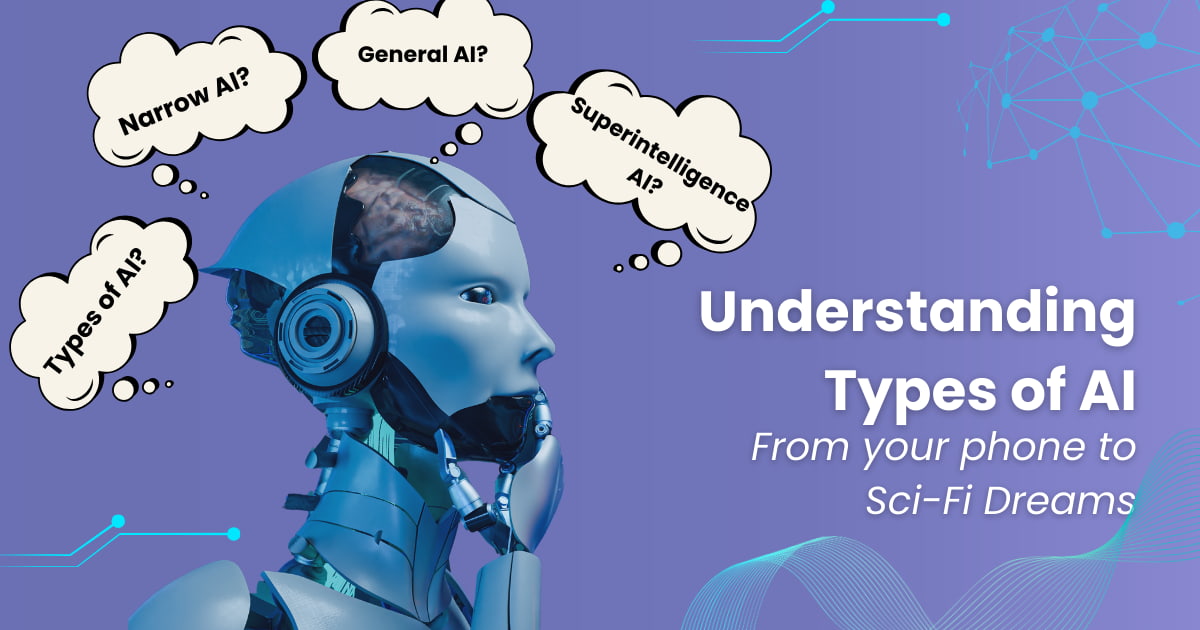
Ever wondered how Types of AI power daily life? How does your voice assistant respond so naturally to “What’s the weather today?” or how might a future AI plan your entire day? That’s the magic of Artificial Intelligence (AI), and it comes in different flavours, each with its superpowers. In my first blog, Artificial Intelligence for Beginners, I explored AI’s basics—its history, pioneers, and real-world impact. If you’re just getting started with AI, you may want to read that first before diving deeper into AI types.
Now, let’s dive deeper into the types of AI: narrow, general, and superintelligence. These aren’t just tech terms—they shape the tools you use today and the dreams of tomorrow. Join me on a story-filled journey to understand what each type does, how they differ, and where they’re headed—all explained like a coffee shop chat. Simple, clear, and easy to get.
What’s one AI tool you use daily (like Netflix or Google Maps)? Share in the comments!
What Are the Types of AI? (Overview)
Artificial intelligence isn’t one-size-fits-all. it’s like a toolbox with different gadgets for different jobs. The three main types of AI are:
Narrow AI, which powers your apps;
General AI, the dream of human-like thinking;
Superintelligence, the sci-fi vision of machines smarter than us.
Each represents a step in AI’s evolution, from the phone in your hand to a future that might blow your mind. Think of them as characters in a story: the reliable worker, the ambitious dreamer, and the mysterious genius. Ready to meet the first character? Let’s start with Narrow AI!
Narrow AI: The Smart Helper You Use Every Day

Simplifying, Narrow AI is designed to do one specific job or task that cannot do anything outside that task. it’s like a very smart specialist, but only in one area.
Narrow AI is the workhorse of today’s tech world, designed to nail one specific task with incredible skill. It’s the brain behind your Netflix recommendations, your phone’s voice assistant, or even the spam filter keeping your inbox clean. Narrow AI works through machine learning, where it learns from data to make decisions.
For example, studying thousands of movie preferences to suggest a thriller or analysing traffic patterns to guide Google Maps and every virtual assistance work in narrow AI i.e, Apple’s Siri, Microsoft Cortana, etc.
Subtypes of Narrow AI:
- Reactive AI: Acts on current data without memory, like IBM’s Deep Blue beating chess champ Garry Kasparov in 1997 by calculating moves on the spot.
- Limited Memory AI: Uses past data to improve, like self-driving cars learning from traffic patterns to avoid jams.
Challenges of Narrow AI
Narrow AI isn’t perfect. It depends on quality data—bad data means bad results, like biased hiring algorithms favoring certain groups. It’s also limited to its training, so a chatbot can’t drive a car.
- Data Dependency: Relies on high-quality data; inaccurate or biased data leads to errors such as bias in hiring or loan approvals.
- Bias & fairness Risk: If the training data is biased, it can lead to unfair judgments—such as bias against a particular community/group
- Ethical Misuse: Creative deepfakes or fake news have become easy.
By 2025, Narrow AI is everywhere: your phone, banking apps, even hospitals. AI systems like those from xAI power chatbots answering customer queries, while medical AI spots diseases like cancer faster than ever.
Future Potential of Narrow AI: By 2030, Narrow AI could personalize education (e.g., apps tailoring math lessons to your pace) or enhance smart cities (e.g., optimizing traffic flow). It’s like a trusty assistant, getting smarter at its job.
Narrow AI is like a librarian who knows every book in one section, getting better each day.
Key Takeaways : Narrow AI
- Narrow AI is designed to perform one specific task or job, such as recommending movies (Netflix), guiding maps (Google Maps), or powering virtual assistants (Siri, Alexa).
- It is the most common and widely used AI today, driving features in smartphones, banking apps, and healthcare tools.
- Narrow AI cannot go beyond its programming; it won’t succeed at tasks outside its domain.
- Key challenges include data dependency and bias: if the training data is flawed, so are the results.
- By 2025, Narrow AI is essential in everyday technology and is rapidly growing across industries
What if AI could master more than one task? Let’s explore General AI next!
General AI: The Dream of Human-Like Thinking

General Artificial Intelligence (AGI) is the holy grail of AI research, a system that thinks like a human across multiple tasks. Unlike Narrow AI, which sticks to one job, AGI could write an email, plan your vacation, and debate your favorite movie, all in one go. It’s not just about data and algorithms; it’s about mimicking human flexibility and creativity.
In simple ways, general AI can understand, learn, and perform any intellectual task that a human being can, such as a human mind with the ability to solve a wide variety of problems and adapt to new situations. This kind of AI does not yet exist.
Challenges of General AI
Generative AI, a star of Narrow AI, faces unique issues
- Context & common sense Reasoning: It is a huge challenge to understand human-like context, subtlety, and common sense.
- Learning & adaptation: Learn quickly from less data like humans do; today’s technology needs lots of data for everything.
- Ethics & Safety: To make someone like this, it takes decisions alienated from human values; it is difficult to work on morality like humans.
How It Differs: Narrow AI is a specialist (e.g., Siri answering questions), but AGI would be a jack-of-all-trades, learning new skills without retraining. For example, imagine an AI that manages your work schedule, cooks recipes, and learns a new language with you.
By 2025, AGI is still a dream. Labs like xAI and DeepMind are experimenting, but no true AGI exists. They’re tackling challenges like understanding human emotions or reasoning across diverse tasks.
Future Potential of General AI: If achieved, AGI could transform work (e.g., managing entire offices), education (e.g., teaching any subject on demand), or even science (e.g., solving complex physics problems). Experts predict we might see early AGI by 2040, but it’s a tough climb.
Think of AGI as a versatile friend who can help with anything, from homework to life advice. Exciting, right? But what if AI surpasses human intelligence? Let’s meet Superintelligence!
Key Takeaways: General AI
- AGI, or general artificial intelligence, seeks to emulate human intellect by learning and completing a wide range of tasks similarly to a person.
- In contrast to narrow AI, AGI is able to swiftly adjust to new circumstances and transfer knowledge across domains.
- Leading labs are still attempting to make AGI a reality; it does not yet exist.
- The development of general artificial intelligence has significant challenges, including assuring moral and secure decision-making, learning from sparse input, and comprehending context.
- AGI has the potential to completely transform labor, education, and creativity on a global scale.
What task would you want a General AI to handle for you? Drop it in the comments!
Superintelligence: The Sci-Fi Vision

Superintelligence is the stuff of sci-fi blockbusters—an AI smarter than humans in every way, from solving math puzzles to composing symphonies. It’s not just about doing tasks better; it’s about outthinking us in creativity, strategy, and even ethics. Picture an AI like JARVIS from Iron Man, but on steroids, running entire cities or solving global crises. In Simple word, Superintelligence AI would be much smarter than the best human minds in nearly every field, including scientific creativity, general wisdom, and social skills. This is a theoretical future AI that could far surpass human intelligence in every possible way
How Super AI Differs: Narrow AI is a tool, General AI is human-like, but Superintelligence is a mastermind, potentially surpassing all human intellect. It’s the ultimate leap in AI’s story.
By 2025, purely theoretical. No Super AI exists, and experts like Yann LeCun argue it’s decades or centuries away—if it’s even possible. The focus is on ensuring it’s safe if it ever arrives.
Future Potential of SuperIntelligence: Super AI could solve humanity’s biggest challenges, like curing diseases or reversing climate change. But it also sparks fears of losing control, as warned by thinkers like Elon Musk. Safety measures, like ethical AI frameworks, are already being debated.
Superintelligence is like a futuristic genius, both thrilling and daunting. How do these types compare? Let’s break it down next!
Key Takeaways: Super Intelligence AI
- Theoretically, superintelligent AI would be superior to the most advanced human minds in all domains, including creativity, reasoning, and problem-solving.
- Superintelligent AI is now purely hypothetical, existing solely in science fiction or future forecasts.
- There are significant risks, such as losing control over AI decision-making, but there are also potential advantages, such as resolving global issues like disease and climate change.
- If Superintelligent AI is ever made a reality, experts emphasize the necessity of rigorous safety protocols and ethical frameworks.
- it marks the height of AI development- a future that is still very far off but will have a significant impact.
Comparing the Types: What Sets Them Apart?
Each AI type is a unique chapter in the tech story, with distinct strengths and limits. Here’s how they stack up:
- Scope:
- Narrow AI: One task at a time (e.g., Google Map Navigation).
- General AI: Multiple tasks like a human (e.g., a versatile assistant).
- Superintelligence: Beyond human ability in all areas (e.g., solving global problems).
- Complexity:
- Narrow AI uses specific algorithms, like machine learning for image recognition.
- General AI needs flexible learning to handle diverse tasks, still under research.
- Super AI requires breakthroughs we can’t yet imagine.
- Examples:
- Narrow: Siri, self-driving cars, medical AI.
- General: Hypothetical all-in-one assistant (not yet real).
- Super: Sci-fi AI like JARVIS or HAL 9000.
- Why It Matters: Narrow AI powers your life now, General AI is the next frontier, and Superintelligence is a distant dream with big implications.
Think of Narrow AI as a bicycle for short trips, General AI as a car for any journey, and Super AI as a spaceship to the stars. Where are these types taking us? Let’s look at the future!
The Future of AI Types: What’s Next?
AI’s journey is just getting started, and each type has a role in shaping tomorrow.
- Narrow AI’s Growth: By 2030, expect smarter tools in healthcare (e.g., AI predicting heart disease from wearables), education (e.g., apps adapting to your learning style), and daily life (e.g., Netflix nailing every recommendation). Narrow AI will keep refining single tasks, like a chef perfecting more recipes.
- General AI’s Pursuit: Labs like xAI are pushing for AGI, aiming for systems that rival human versatility. By 2040, we might see early AGI managing complex tasks, like running a business or personalizing education globally. But challenges like computing power and ethical risks remain.
- Superintelligence’s Debate: If Super AI arrives, it could solve global issues—think curing cancer or optimizing energy grids. But experts like Geoffrey Hinton warn of risks, like AI outsmarting us in unintended ways. Ethical frameworks are being built now to ensure safety.
Picture a future where AI evolves from your phone to a partner tackling humanity’s biggest challenges. Exciting or scary? Share your thoughts below, and we’ll dive into AI’s impact in a future blog!
Which AI future excites or worries you? Share in the comments!
Wrapping Up: Your Journey with AI Types
From Narrow AI running your apps to General AI’s human-like dreams and Superintelligence’s sci-fi potential, AI types tell a story of tech transforming our world. Narrow AI is your daily helper, General AI is the next big leap, and Super AI sparks both hope and caution. Knowing these types helps you navigate AI’s role in your life and future. Try a Narrow AI tool like ChatGPT or follow AI news on X to stay curious. Next, we’ll dive into how AI learns (machine learning and more) or its coolest apps. Stay tuned!
What did you learn about AI types today? Drop a comment, and let’s keep the chat going!
If you found this helpful but want a simpler introduction, you can just head over to my blog A beginner-friendly AI Overview, where I explain AI from scratch in an easy, story-like way.
FAQs About AI Types
Got questions? Here are answers to spark your curiosity:

